Why Autonomy Is Essential for AI Agents
The difference between a chatbot and a true AI agent isn't intelligence, it's the ability to act independently. Here's why autonomy is the missing piece in your AI strategy, and how Plugged.in is building agents that can think, remember, perceive, and act on their own.
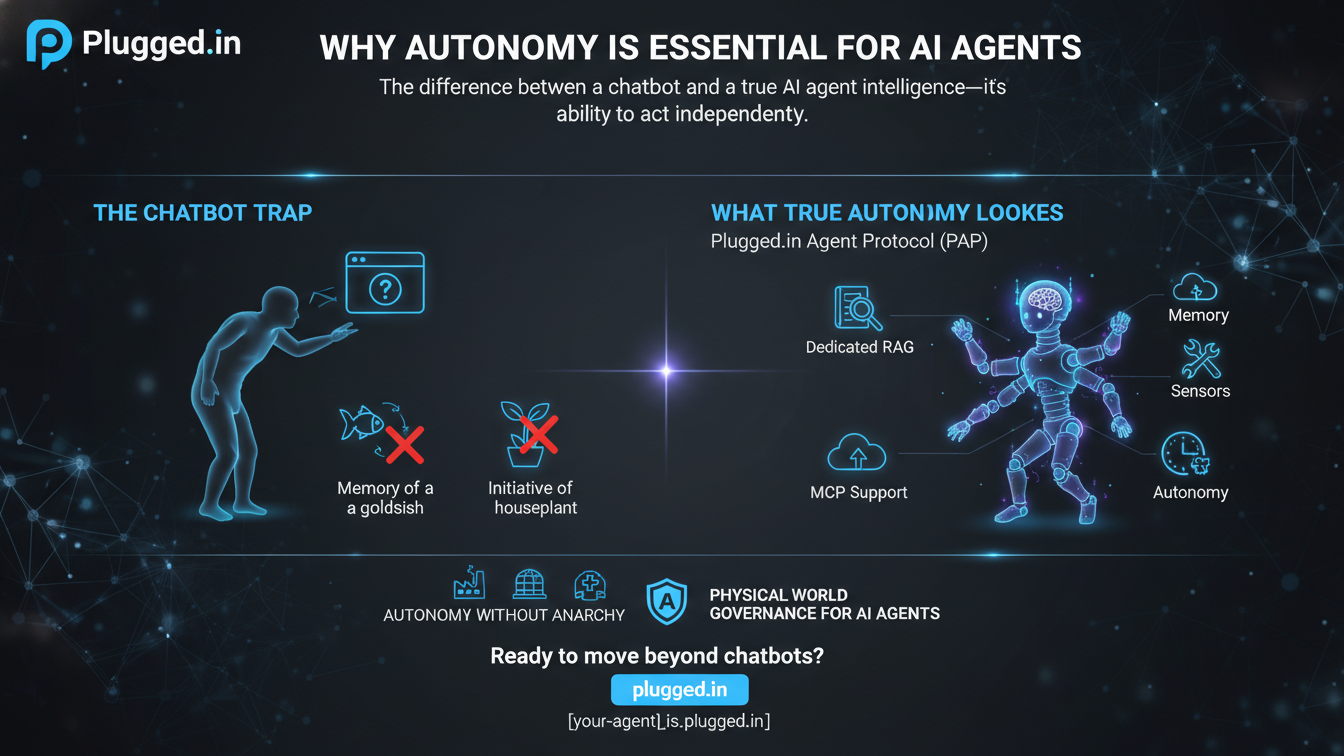
We've all experienced the frustration. You're deep into a conversation with an AI, building context, making progress—then you close the browser tab. Gone. Tomorrow, you'll start from zero. That brilliant assistant? It has the memory of a goldfish and the initiative of a houseplant.
This isn't a failure of AI intelligence. It's a failure of architecture.
Today's AI assistants are fundamentally reactive. They wait for your prompt, generate a response, then go dormant. They can't monitor your systems while you sleep. They can't remember what you discussed last week. They can't sense changes in your environment or take proactive action when something goes wrong.
At Plugged.in, we believe the next evolution of AI isn't about making models smarter—it's about giving them the infrastructure to operate autonomously. That's why we built the Plugged.in Agent Protocol (PAP), and why every agent on our platform is designed around five essential pillars: Dedicated RAG, MCP Support, Memory, Sensors, and Autonomy.
The Chatbot Trap
Consider how most people use AI today. You open ChatGPT or Claude, type a question, get an answer, move on. For simple queries, this works fine. But for anything requiring continuity—managing a project, monitoring systems, learning your preferences—the request-response model breaks down completely.
The problem isn't that AI models lack capability. GPT-4 and Claude can reason, plan, and even use tools when instructed. But they operate in isolated sessions with no persistence, no state, and no ability to act without explicit prompting.
Imagine hiring an employee who forgets everything the moment they leave your office. Who has no access to your company's documents. Who can't use any of your business tools. Who can only work when you're actively watching them. You'd never hire that person for anything important.
Yet that's exactly what we expect from AI assistants today.
What True Autonomy Looks Like
An autonomous agent is fundamentally different. It's not just an AI that responds to questions—it's an AI that operates. It runs continuously, maintains state across sessions, accesses knowledge when needed, uses tools to take action, and perceives its environment through sensors.
When we complete PAP and our agent infrastructure, every Plugged.in agent will have:
Dedicated RAG (Retrieval-Augmented Generation): Each agent gets its own knowledge base. Upload your SOPs, technical documentation, customer data—whatever your agent needs to do its job. Unlike generic AI that hallucinates when it doesn't know something, your agent queries its dedicated knowledge store and responds with grounded, accurate information with source attribution.
MCP Support: Through the Model Context Protocol, agents gain access to over 7,000 tools and 1,500+ server integrations. They can query databases, call APIs, send notifications, control devices, create tickets—any action that can be exposed as an MCP tool becomes available to your agent. The principle is simple: AI should do things, not just talk about doing things.
Memory: Short-term and long-term memory that persists across sessions. Your agent remembers past conversations, learns your preferences, tracks project history, and builds understanding over time. And critically, this memory isn't locked to a single AI model—switch from Claude to GPT to Gemini, and your context comes with you.
Sensors: For agents operating in the physical world, real-time data feeds from IoT devices, monitoring systems, and environmental sensors. An agent monitoring a factory floor needs vibration, temperature, and pressure data. An agent managing a greenhouse needs humidity and light levels. Sensors give agents perception of the world beyond text.
Autonomy: The capstone that makes everything else valuable. Your agent doesn't wait for prompts—it operates continuously, makes decisions based on its knowledge and sensor inputs, and takes action through its tools. It runs 24/7, even when you're not watching.
And every agent will be directly accessible at
[name].is.plugged.inAutonomy Without Anarchy
Here's where most autonomous agent discussions go wrong: they assume giving AI freedom means losing control. Either you have a reactive chatbot you can trust, or an autonomous agent that might go rogue.
This is a false dichotomy.
PAP—the Plugged.in Agent Protocol—was designed around a single mantra: autonomy without anarchy. Agents are free to operate independently, but they're never unsupervised. Every agent maintains a heartbeat connection to the Station (our control plane). Every action is logged and auditable. Every agent can be immediately terminated with a kill-switch if needed.
The lifecycle is rigorous: agents progress through defined states (NEW → PROVISIONED → ACTIVE → DRAINING → TERMINATED), with the Station maintaining exclusive control over transitions. An agent cannot refuse to terminate. It cannot hide its activities. It cannot exceed its resource limits or permission boundaries.
Think of it like deploying a container in Kubernetes. Your container runs autonomously, handling requests and doing its job. But the orchestrator always knows its status, can scale it up or down, and can kill it instantly if necessary. PAP brings this same production-grade discipline to AI agents.
This matters because trust is earned incrementally. You want to start agents with tight constraints—maybe they can only read data, not write it. Maybe they can only operate during business hours. Maybe they require approval for certain actions. As you gain confidence, you expand their permissions. But at every step, the Station maintains oversight.
The Edge of AI
Autonomy becomes even more critical when AI moves to the physical world. Consider a predictive maintenance agent monitoring factory equipment. It needs to continuously ingest sensor data, analyze patterns, and alert operators before failures occur. This isn't something you can do with prompt-response conversations.
Or consider a greenhouse management agent controlling irrigation and climate systems. It reads humidity sensors, checks weather forecasts, references plant care knowledge, and adjusts actuators—all in real-time, all automatically. The farmer sets the goals; the agent handles the execution.
This is what we mean by "Physical World Governance for AI Agents." Not AI that talks about the physical world, but AI that perceives and acts within it. Edge devices running lightweight agents, connected via secure channels to the central platform, continuously operating even with intermittent connectivity.
The implications are profound. Domain experts—farmers, maintenance technicians, nurses, educators—become the new AI programmers. They don't write code; they describe what they want in natural language. They upload their domain knowledge. They connect their sensors and tools. And they deploy agents that embody their expertise, operating autonomously at scale.
Why This Matters Now
We're at an inflection point. AI models have become capable enough to reason, plan, and use tools effectively. The protocols for tool integration (MCP) are maturing. The infrastructure for running persistent, stateful agents (PAP) is coming online.
What's been missing is the comprehensive platform that brings it all together—knowledge, memory, tools, sensors, and autonomy—under one roof. That's what Plugged.in is building.
The era of the reactive chatbot is ending. The era of the autonomous agent is beginning. And the winners will be organizations that can deploy trusted, governed, persistent AI agents that work alongside humans—not as tools to be used, but as team members to be managed.
Ready to move beyond chatbots?
Plugged.in is building the infrastructure for autonomous AI agents that know your domain, remember your context, use your tools, and operate on your behalf. Join us at plugged.in to be part of what comes next.
Follow our journey as we build the future of AI autonomy. The next generation of agents won't wait for your prompts—they'll be working for you around the clock, accessible at [your-agent].is.plugged.in