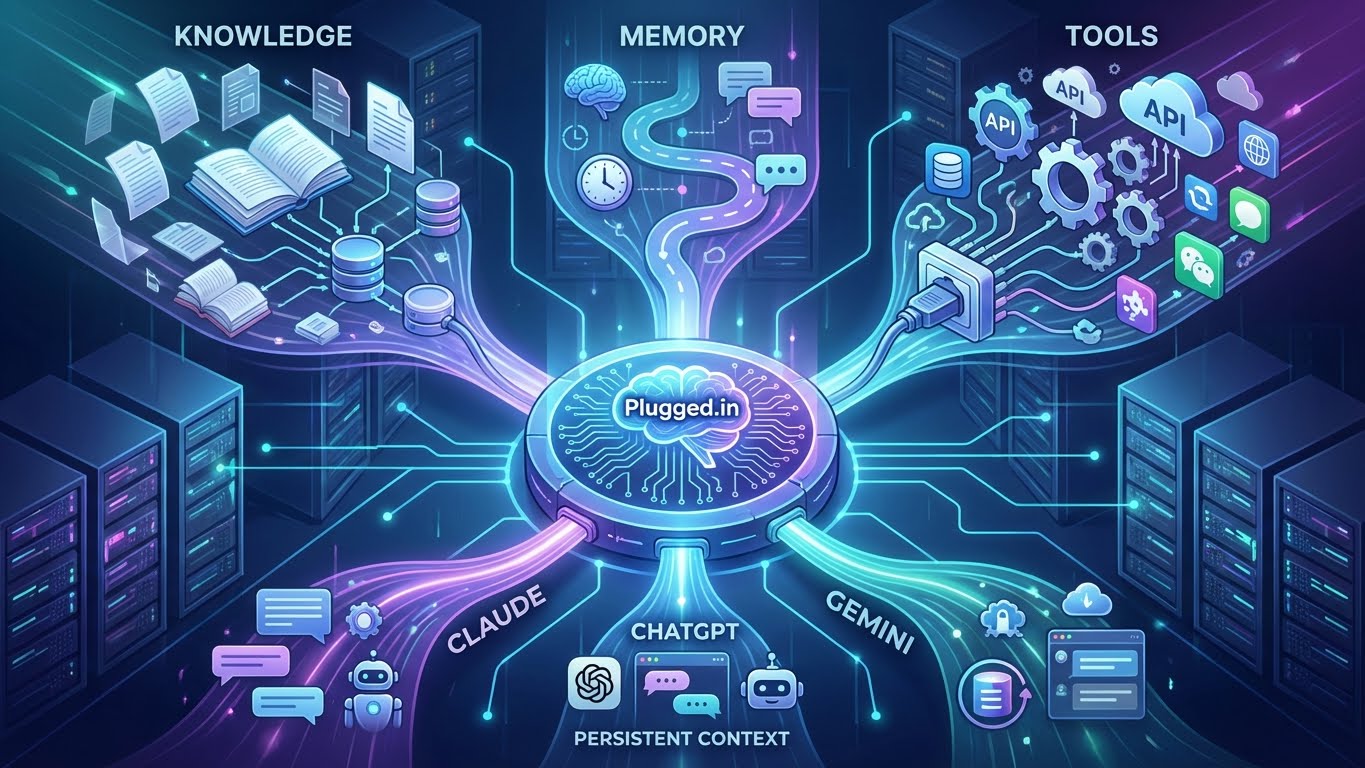
What is Plugged.in? The AI Control Plane That Keeps Your Knowledge, Tools, and Memory in One Place
Your AI conversations are valuable. Stop letting them disappear.
Every day, millions of people have transformative conversations with AI. They brainstorm business strategies with ChatGPT, debug complex code with Claude, explore creative ideas with Gemini. And then... it all vanishes. Switch to a different AI model, and you start from zero. Close your browser, and weeks of accumulated context evaporate. Your AI doesn't remember your preferences, your projects, or the breakthroughs you had yesterday.
This is the problem of AI knowledge evaporation—and it's costing individuals and organizations countless hours of repeated context-setting, lost insights, and fragmented workflows.
Plugged.in exists to solve this.
The World's First AI-CMS: Knowledge, Memory, and Tools Under One Roof
Plugged.in is more than another AI tool—it's the unified control plane for your entire AI ecosystem. Think of it as a content management system, but instead of managing websites, it manages your relationship with artificial intelligence.
At its core, Plugged.in rests on three foundational pillars:
Knowledge: Your documents, expertise, and domain-specific information—always accessible to any AI you work with. Upload your company handbook, your research papers, your project documentation. Our RAG-powered document library transforms static files into dynamic context that makes every AI interaction smarter.
Memory: Your preferences, your history, your context—persistent across sessions and models. The Named Clipboard system lets AI agents pass data between tools, store intermediate results, and maintain working memory across complex multi-step workflows.
Tools: Thousands of integrations through the Model Context Protocol (MCP)—standardized connections to databases, APIs, cloud services, and custom scripts. One unified interface to give any AI model access to the capabilities it needs.
Connect Your Way: MCP, SDKs, or Direct API
Here's what makes Plugged.in different from typical AI platforms: MCP servers aren't the only way to connect. We've built multiple integration paths so you can work with Plugged.in however fits your workflow best.
The MCP Proxy
For MCP-compatible AI clients like Claude Desktop, Cursor, or Cline, our proxy aggregates all your configured tools into a single connection point. Configure once, use everywhere. The proxy handles routing, authentication, and session management automatically.
Official SDKs for Your Language
Not using an MCP client? No problem. We provide first-class SDKs for the three most popular programming languages:
JavaScript/TypeScript
bashnpm install pluggedinkit-js
Full async support, comprehensive type definitions, and works in both Node.js and browser environments. Available on npm.
Python
bashpip install pluggedinkit
Both synchronous and async clients, Pydantic models for type safety, and automatic retry logic. Available on PyPI.
Go
bashgo get github.com/veriteknik/pluggedinkit-go
Context-aware operations, full type definitions, and idiomatic Go patterns. Available via Go modules.
Each SDK provides complete access to every Plugged.in capability: document management, RAG queries, file uploads, clipboard operations, and notifications. Build AI-powered applications in your language of choice without touching MCP at all.
REST API
For languages we don't yet have SDKs for—or if you prefer direct HTTP calls—our REST API is fully documented and ready to use. Every feature available through the SDKs is available through the API.
The Complete Platform: What You Can Build
Plugged.in isn't a single feature—it's an ecosystem. Here's what's available today:
RAG-Powered Document Library
Upload documents in any format—PDFs, Word files, Markdown, plain text. Our RAG pipeline processes them into searchable, queryable knowledge that any AI can access.
Key capabilities:
- Semantic search with relevance scoring
- Filter by AI model, provider, date, tags, and source type
- Automatic snippet generation with keyword highlighting
- Version control with parent-child relationships
- Project-based isolation for workspace organization
The
pluggedin_rag_queryNamed Clipboard: Working Memory for AI Agents
Multi-step AI workflows need somewhere to store intermediate results. The Named Clipboard provides exactly that—a key-value store designed for AI agent pipelines.
typescript// Tool 1 parses data
await client.clipboard.setNamed('parsed_data', JSON.stringify(rows));

// Tool 2 analyzes it
const data = await client.clipboard.getByName('parsed_data');
await client.clipboard.setNamed('analysis', insights);

// Tool 3 generates the report
const results = await client.clipboard.getByName('analysis');
Features include configurable TTL, visibility controls (private, workspace, public), content type support for JSON, images, and binary data, and full MCP tool integration.
Real-Time Notifications
Keep track of what your AI agents are doing. Every MCP operation can trigger notifications with optional email delivery. Build alerting systems, audit trails, or just stay informed.
The
pluggedin_send_notificationInteractive Playground
Test your MCP configurations before deploying them. The Playground supports multiple AI models (Claude, Gemini, OpenAI), virtualized conversations for handling long contexts, custom instructions, and comprehensive logging.
Enterprise-Grade Security
When we say "enterprise-ready," we mean it. Our founders come from two decades of datacenter operations, ISO 27001 auditing, and PCI-DSS compliance work. Security isn't a feature we added—it's the foundation everything else is built upon.
End-to-end encryption: All sensitive MCP server configurations—commands, arguments, environment variables, URLs—are encrypted at rest using AES-256-GCM. Each workspace has its own derived encryption key, ensuring complete isolation.
Cryptographically secure key derivation: We use scrypt with random salts for key derivation, not predictable patterns. The v2.10.0 release included a comprehensive security migration addressing CodeQL findings.
Per-profile isolation: Your configurations, documents, and interactions are siloed by workspace. What happens in Project A stays in Project A.
OAuth 2.1 compliance: Modern authentication standards with automatic token management, refresh mechanisms, and RFC 9728 auto-discovery for Streamable HTTP servers.
SSRF protection: Our proxy blocks requests to localhost, private IP ranges, and internal services—preventing AI models from being tricked into accessing resources they shouldn't.
Command allowlisting: Only approved commands (node, npx, python, etc.) can be executed by STDIO servers. Header validation prevents injection attacks.
Production-Ready Infrastructure
Plugged.in isn't just an app—it's a complete infrastructure stack designed for production deployments.
Observability Stack
Our pluggedin-observability repository provides:
- Prometheus for metrics collection
- Grafana dashboards for visualization
- Loki for log aggregation
- Traefik for reverse proxy and SSL termination
Pre-built dashboards monitor RAG query performance, MCP operations, session management, OAuth flows, and infrastructure health. Fifty-plus alert rules cover everything from service availability to latency thresholds.
Registry Integration
The MCP Registry at registry.plugged.in provides server discovery, installation tracking, and community server support. Our registry-proxy handles authentication, routing, and analytics.
Self-Hosting
Every component is self-hostable. Docker Compose configurations, systemd service files, and comprehensive documentation mean you can run your own Plugged.in infrastructure with full control over your data.
Comprehensive Documentation
We believe great software deserves great documentation. docs.plugged.in provides:
- Getting Started guides for each integration method
- API Reference with complete endpoint documentation
- SDK guides with examples for JavaScript, Python, and Go
- Security documentation covering encryption, authentication, and compliance
- Self-hosting guides for production deployments
- Troubleshooting for common issues
Where We're Heading: The Plugged.in Agent Protocol
Everything we've built so far is the foundation. The real vision goes much further.
PAP v1.0.0: Autonomy Without Anarchy
The Plugged.in Agent Protocol (PAP) is our framework for autonomous agent lifecycle management. The v1.0.0 release—our first stable version—establishes the foundational framework with:
Dual-Profile Architecture: PAP-CP (gRPC/mTLS) for control plane operations and PAP-Hooks (JSON-RPC/OAuth) for webhook integrations.
Strict Lifecycle Management: Agents follow a normative lifecycle from NEW → PROVISIONED → ACTIVE ↔ DRAINING → TERMINATED. Every transition is tracked and auditable.
Zombie Prevention: Heartbeat and metrics are strictly separated. Miss too many heartbeats, and the platform intervenes automatically.
Cryptographic Identity: Ed25519 signing, mTLS authentication, and nonce replay protection ensure every agent is who it claims to be. DNS-based identity (
{agent}.{cluster}.a.plugged.inThe specification includes a complete RFC, deployment guides, and an academic paper draft for arXiv submission. SDK scaffolding exists for TypeScript, Python, Go, and Rust.
The New Builders
Here's what we believe most deeply: AI didn't eliminate coding—it changed who can code.
The next generation of builders won't necessarily write Python or JavaScript. They'll describe what they want in plain language, and platforms like Plugged.in will translate that intent into deployed solutions. A supply chain expert shouldn't need a CS degree to automate inventory monitoring. A healthcare administrator shouldn't need to hire a developer to build a patient follow-up system.
We're building natural language interfaces that compile human intent into agent configurations. Describe your workflow in English, and Plugged.in handles the rest—the tool orchestration, the scheduling, the error handling, the monitoring.
This is what we mean by democratizing autonomous AI development. Not dumbing it down, but opening it up.
The Road Ahead: 2025 and Beyond
Our roadmap is ambitious but grounded:
Now - Q2 2025: Platform stabilization, SDK expansion, and embedded chat functionality that lets any website add AI capabilities powered by Plugged.in infrastructure.
Q3-Q4 2025: PAP moves from specification to production. The first autonomous agents deploy, handling real workloads with real oversight.
2026: Edge AI goes live. The platform extends beyond the cloud to physical infrastructure, with zero-touch provisioning that makes deployment as simple as plugging in a device.
By Q4 2026, our goal is clear: prove that AI agents can be trusted co-workers, not just experimental chatbots.
Get Started Today
Plugged.in is live and ready for you to build with.
Cloud-hosted: Sign up at plugged.in and start in minutes. Free tier available.
Self-hosted: Clone our repositories from GitHub and deploy on your own infrastructure.
SDKs: Install via npm, pip, or go get and start building immediately.
Documentation: Everything you need at docs.plugged.in.
Community: Join our Discord to connect with other builders.
The age of AI fragmentation is ending. The age of AI infrastructure is beginning.
Welcome to Plugged.in. Let's build something together.
Plugged.in is the AI control plane for knowledge, memory, and tools. Current versions: pluggedin-app v2.12.0, pluggedin-mcp v1.4.0, PAP v1.0.0.